








Dr. Hugh Cutcher
August 10, 2026
Share this post
On 12 August 2026, a total solar eclipse will track from Siberia across the Arctic, Greenland and Iceland to reach northern Spain and north-eastern Portugal, marking the first total solar eclipse over mainland Europe since 1999. Much of the rest of Europe will see a deep partial eclipse in the early evening, while parts of the eastern United States and Quebec will see a smaller partial eclipse around midday. Eclipse events are a challenging real-world test for balancing solar-powered grids, due to the uniform and wide-scale drop in irradiance across every solar asset. Markets with lots of behind-the-meter rooftop solar also see a ramp in load on the grid, that is correlated with the drop in renewables, potentially testing response and peaking capacity and storage dispatch.
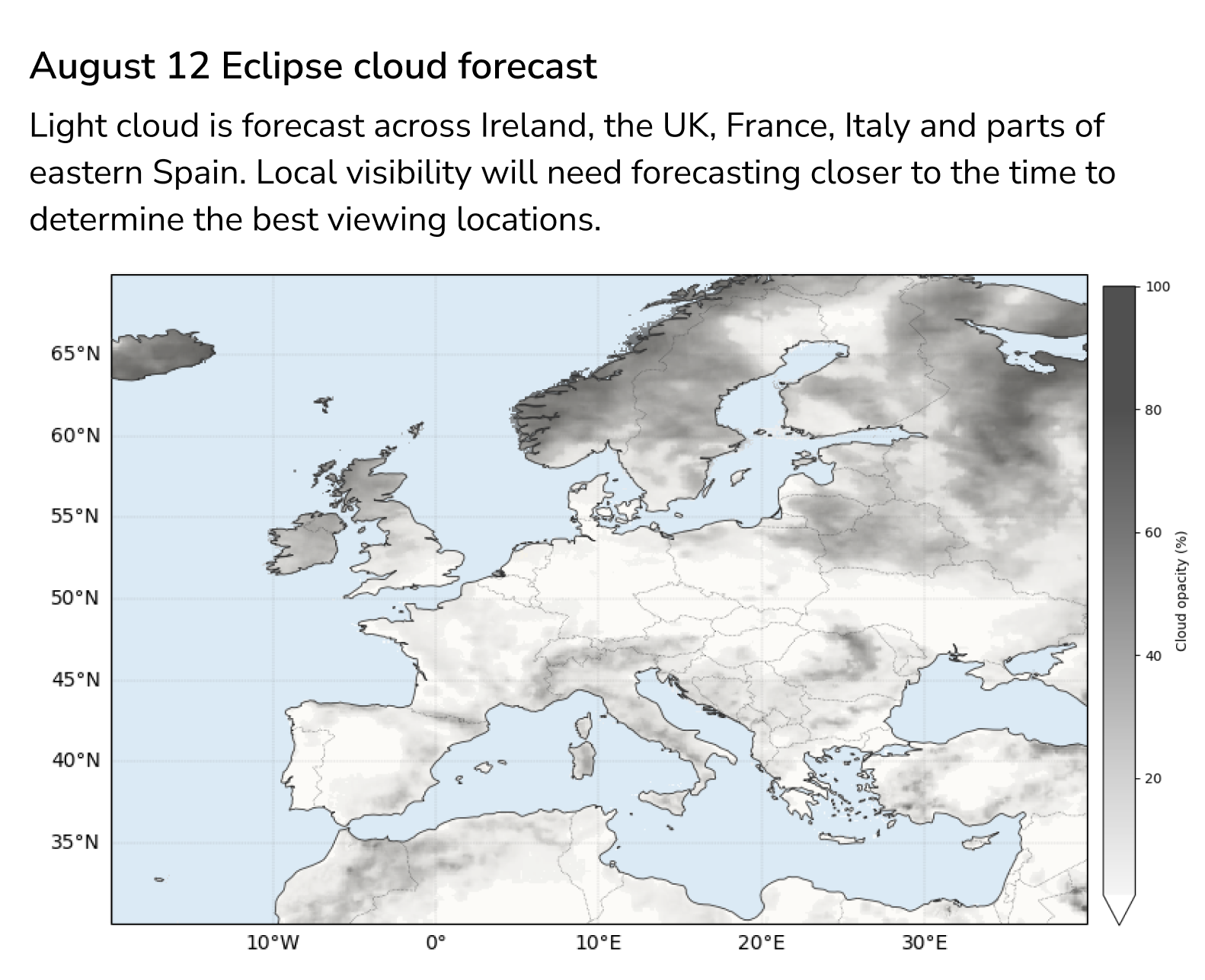
Cloud cover will determine how much of the eclipse is actually visible from the ground, and the severity of the grid impacts. Current forecasts suggest better viewing conditions in Madrid, Paris and London, with cloud opacity generally remaining below 25% during the eclipse. Amsterdam and Berlin are more likely to experience greater cloud interference, with cloud opacity forecast for around 40% and 35% respectively. Reykjavik, despite lying within the path of totality, is forecast to experience much cloudier conditions, with cloud opacity of around 60-80% potentially obscuring the views of the eclipse event.
Across Europe, the eclipse occurs during the evening, with maximum eclipse occurring at approximately 17:48 local time in Reykjavik, 19:13 local time in London (BST), 20:17 in Paris, 20:10 in Amsterdam, 20:08 in Berlin and 20:32 in Madrid (all CEST). Because the sun will already be low in the western sky, visibility will also depend on having an unobstructed western horizon.
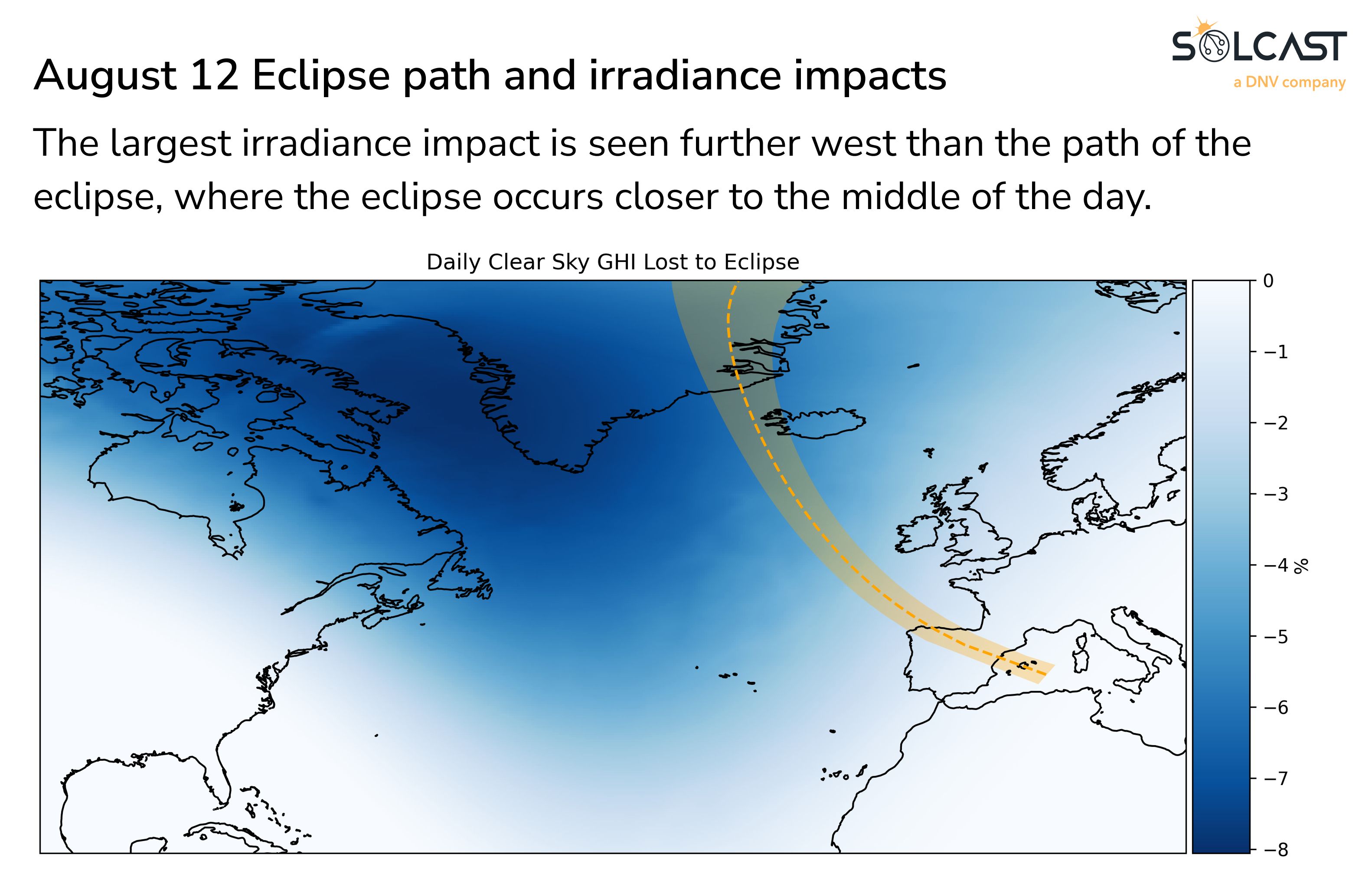
Counterintuitively, the largest daily irradiance losses are not expected beneath the deepest eclipse. Only around 1% of daily irradiance is expected to be lost across most of Spain, Portugal, France and the UK, because the eclipse there occurs late in the day, when the Sun is already low and contributing little to the day's total. By comparison, Iceland is projected to lose close to 3% of daily irradiance and Greenland up to 6%, despite experiencing a less complete eclipse. As the impact on daily irradiance is a function of time of day, and depth of eclipse, the greatest impacts are felt further west of the eclipse path where the eclipse occurs earlier in the day.
The same principle applies across North America. While only a partial eclipse will be visible across parts of the eastern United States and Quebec, the event occurs much closer to solar noon. As a result, New York is expected to lose around 2% of daily irradiance, while Quebec may see losses of 3% to 4%.
Solcast's grid aggregation modelling shows that small daily irradiance losses can still create significant operational challenges for electricity networks. Germany, despite losing only around 1% of its daily irradiance, is projected to see both the largest total loss and the sharpest ramp of any region studied — an estimated 1,400 MWh lost and a maximum ramp rate of 13,600 MW/h as generation recovers. France is forecast to lose 540 MWh, with a 5,070 MW/h ramp.
The Netherlands and the UK are expected to lose a similar amount of energy overall (1,150 MWh and 1,190 MWh), but with very different ramp profiles: the Netherlands' 6,230 MW/h maximum ramp is considerably steeper than the UK's 4,420 MW/h.
Across North America, the impacts are smaller: ISO-NE is expected to lose 520 MWh with a 1,350 MW/h ramp, and NYISO 340 MWh with an 840 MW/h ramp. Europe's steeper ramp rates stem directly from timing again: the eclipse-driven dip and the natural approach of sunset happen in close succession, forcing grids to absorb both within a short window.
How do I track the impact of eclipse on my solar projects?
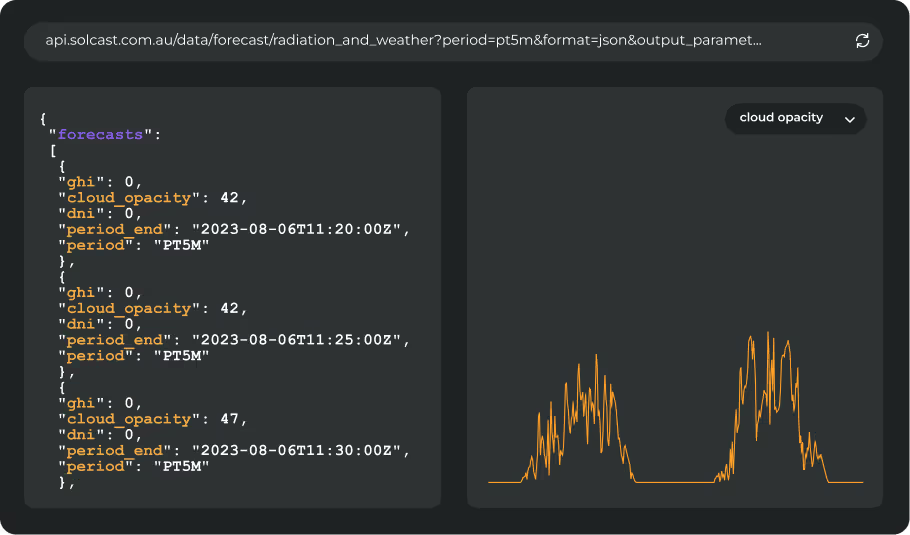
You can access Solcast actuals and forecast data for evaluation purposes instantly and for free by creating a Commercial Toolkit account. With your API key from your account you can use the Solcast SDK, or integrations with pvlib and PVSyst to pull Solcast data into your existing generation models.